To ship one pallet from China, first define the finished pallet—not just the products on it. You need the outside dimensions, gross weight, commodity, value, pickup point, final destination, readiness date and handling limits. Those details determine whether air freight, ocean LCL, a dedicated load or a door-to-door service is practical. This guide explains the complete process, the costs to compare and the checks that protect a single-pallet shipment.
How to ship one pallet from China: the quick answer
Ask the supplier to finish export packing and provide the final pallet dimensions and gross weight. Confirm that the goods can be exported from China and imported at destination. Compare air freight when timing matters with ocean LCL when the pallet is dense, planned and suitable for shared-container handling. Request every quotation to the same endpoint, with origin, freight, customs and delivery items separated.
A single pallet is not automatically a simple shipment. A 120 × 100 × 90 cm pallet of textiles, a 120 × 100 × 180 cm pallet of electronics and a 100 × 100 × 80 cm pallet containing a 900 kg machine create different handling, pricing and safety requirements. The carrier needs the packed unit, not a catalogue description, to decide acceptance and cost.
Minimum quote data
Pickup city and postcode; delivery city and postcode; commodity and intended use; package count; final length × width × height; gross weight; value and currency; stackable or non-stackable status; readiness date; photographs; and the services required at origin and destination.
Start with the cargo, route and commercial responsibility
Describe the product precisely
Use a commercial description that explains what the goods are, what they are made from and what they do. “Parts,” “samples” or “general cargo” is usually too vague for a reliable acceptance or customs review. State whether the shipment contains batteries, magnets, liquids, powders, chemicals, food-contact items, medical products, branded goods or solid wood packaging. A restriction discovered after pickup can create storage and rework.
Name the actual endpoints
“China to Europe” or “China to Latin America” is not enough. A pickup near Shenzhen and a pickup in inland Sichuan have different origin transport. A commercial warehouse near a major port and a residential address inland have different delivery equipment and access. Give postcodes and state whether the destination has a loading dock, forklift, delivery appointment or restricted road.
Separate freight terms from service scope
Incoterms describe responsibilities between seller and buyer, but a logistics quotation still needs a named origin, named destination and list of included services. A port-to-port LCL rate does not include every origin and destination charge. A DDP proposal should identify customs assumptions, duties and taxes, delivery point, unloading responsibility and exclusions.
Prepare one pallet for international handling
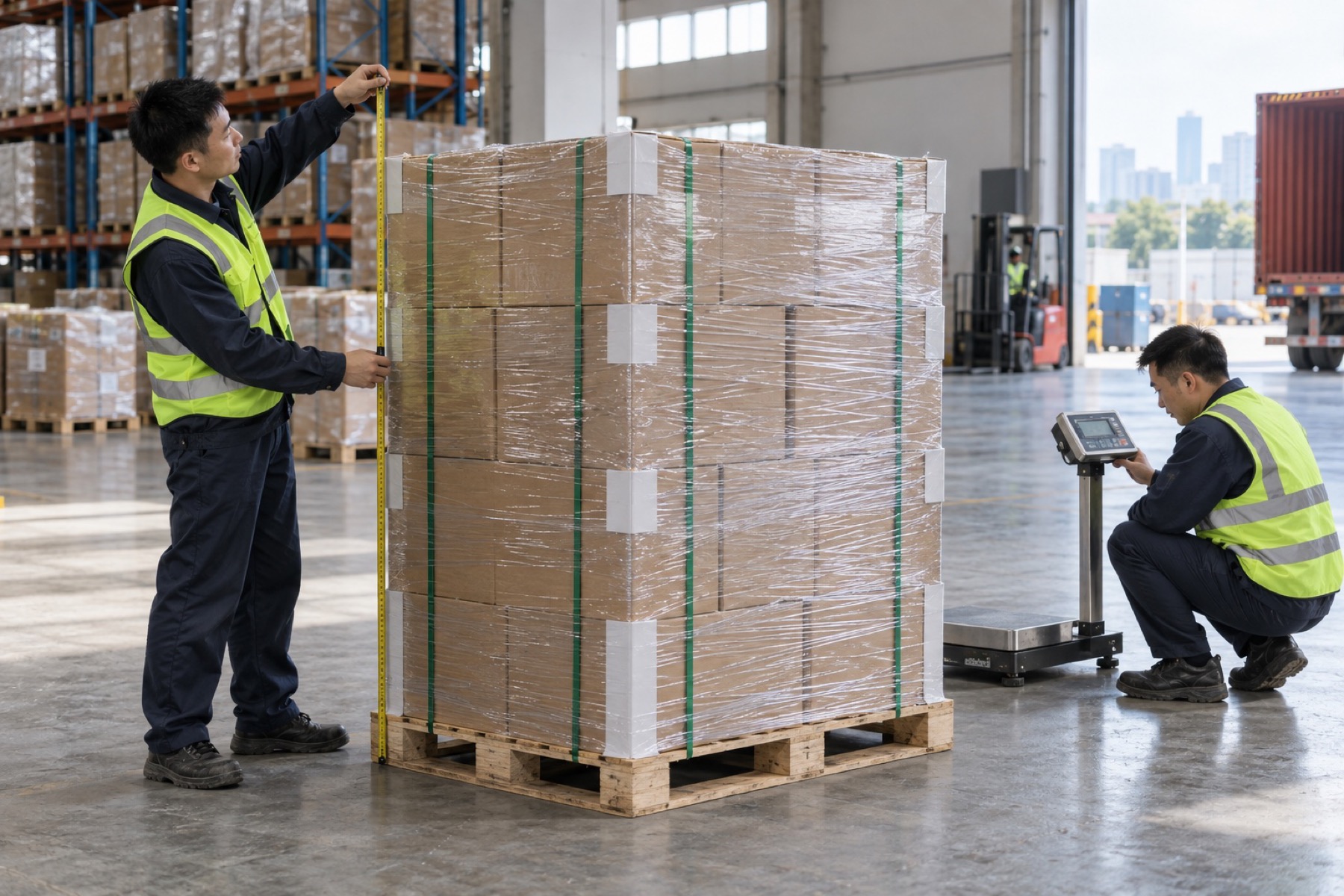
The pallet must support the cargo during forklift moves, warehouse storage, truck transport, terminal handling and the international journey. Cartons should stay within the pallet footprint when practical. Overhang exposes edges to impact and can change the measured width. Heavy cartons belong low, lighter cartons high, and the load should be balanced around its centre.
Use corner boards, stretch film and correctly applied strapping where suitable. Stretch film contains and protects the cartons; it is not a substitute for structural restraint. Straps should secure the load to the pallet without crushing cartons or crossing sharp edges unprotected. For equipment or irregular cargo, a designed crate, base, blocking and bracing may be required instead of a standard carton pallet.
Mark each handling unit consistently with consignee or reference, package number and destination information agreed with the provider. Remove obsolete labels that could cause misrouting. If the goods are fragile, sensitive to moisture, cannot be stacked or require a particular orientation, communicate the handling requirement in the booking and packing design; a sticker alone cannot make an unstable load safe.
Solid wood and ISPM 15
Many countries regulate solid wood packaging to reduce pest risk. Pallets, crates, boxes and dunnage made from raw wood may need approved treatment and the ISPM 15 mark. Processed wood products such as some plywood materials can be treated differently, but acceptance must be confirmed for the actual construction and destination. Do not add or copy a mark yourself; it belongs to an authorized treatment system.
Measure the pallet and calculate chargeable quantity
Measure the longest outside length, widest outside width and total height from floor to the highest point. Include the pallet base, corner protection, wrapping, straps and any protrusion. Record gross weight, including all packaging. Warehouse remeasurement can replace supplier estimates, so use finished data before making a budget commitment.
For ocean freight, calculate cubic metres: length in metres × width in metres × height in metres. A finished pallet measuring 1.20 × 1.00 × 1.45 m occupies 1.74 CBM. LCL tariffs commonly use a weight-or-measure basis: the provider compares volume with weight under its stated conversion and minimum, then applies the chargeable unit. Local handling can have separate minimums.
Air freight compares actual gross weight with volumetric weight under the carrier’s current rule. The divisor is not universal across every product and service, so the quote should show the chargeable weight used. A tall, light pallet can cost much more by air than its scale weight suggests. Pallet dimensions must also fit aircraft and handling limits on the selected route.
If the pallet cannot be stacked, tell the provider before quotation. A non-stackable unit can consume usable space above it and may attract different pricing or acceptance. Do not declare a pallet stackable unless the top surface and packaging can safely carry another load through normal transport forces.
Air freight or ocean freight for one pallet?
Choose air when timing and inventory value justify it
Air can suit compact, high-value, time-sensitive goods. It may reduce transit time and inventory interruption, but cost depends on chargeable weight, security screening, route and final delivery. Battery-powered products, magnets, liquids and other regulated items need proper acceptance information. “Air freight” can also mean airport-to-airport or a complete door service, so align the scope.
Choose ocean LCL for planned, suitable cargo
Ocean LCL places the pallet in a shared container with other shipments. It is often considered for planned general cargo where the complete cost and longer lead time fit the business requirement. The pallet will pass through consolidation and deconsolidation facilities, so packaging must tolerate more handling. Destination charges should be reviewed before booking.
Consider a dedicated option when handling risk dominates
One pallet rarely needs a full container on volume alone, but unusually heavy, sensitive, high-value or difficult cargo may justify a dedicated vehicle, special equipment or different transport plan. The decision should be based on safe handling and total risk, not a rule that every pallet must travel LCL.
What happens to one pallet in ocean LCL
The supplier or pickup truck delivers the pallet to a consolidation warehouse or container freight station. The warehouse checks package count and visible condition, measures and weighs the unit, and records receipt. The consolidator plans compatible cargo into a container. After export procedures and terminal delivery, the container moves under the booked ocean service.
At destination, the container is moved to a facility and opened for deconsolidation. The pallet becomes available after carrier and warehouse procedures, then customs clearance and final delivery are coordinated. This means LCL lead time includes more than the vessel passage. It also explains why origin and destination CFS charges matter in a complete quotation.
Cargo compatibility deserves attention. Odorous, leaking, hazardous or poorly secured goods can affect other shipments. Fragile merchandise needs packaging appropriate for shared handling. Ask how the pallet is received, whether extra storage begins after a free period and which party will provide import documents before arrival.
Customs and documents for a single pallet
A small shipment is still a commercial import when the facts make it one. Typical core documents include a commercial invoice, packing list and transport document. The product and country may require certificates, licences, test reports, origin evidence or other records. The consignee or customs representative should confirm the final set before departure.
The commercial invoice should use an accurate product description, quantity, unit and total value, currency, seller and buyer data, and agreed trade term. The packing list should match the physical pallet: package count, marks, net and gross weight, and dimensions where required. Contradictions can delay customs and warehouse release.
Classification and customs value affect duty, tax and controls. Do not choose an HS code merely because it produces a lower rate. Provide composition, function, photographs and technical information to the qualified customs party in the destination country. DDP does not remove product regulation; it changes how the agreed responsibilities are coordinated.
What determines the total cost
The international freight line is only one component. Origin cost can include supplier pickup, warehouse receiving, measurement, export documentation, storage, repacking and terminal handling. Main transport depends on chargeable volume or weight, route, carrier, capacity and current surcharges. Destination can include deconsolidation, documents, customs brokerage, duty, tax, inspection, storage and final delivery.
Compare quotations at the same named endpoint. A cheap port rate can become expensive after destination charges, while a higher door quotation may simply include more work. Ask for validity, chargeable quantity, route assumptions, inclusions and exclusions. If duties and taxes are estimated, ask which classification, customs value and importer arrangement support the estimate.
Insurance is separate from safe packing. Carrier liability can be limited and may not match the invoice value. Consider cargo insurance based on value and risk, and retain purchase, inspection, packing and condition evidence. Confirm how a claim would be reported and what documents would be required.
A practical single-pallet shipping process
1. Confirm product and destination acceptance
Review the commodity, destination rules, consignee status and any special characteristics before the supplier finishes packing.
2. Approve export packing
Ask for the proposed pallet material, carton arrangement, protection and labels. For sensitive goods, use a packing design related to weight and handling, not a generic visual standard.
3. Inspect and close the order
A shipment inspection can verify count, visible condition, selected product checks, carton marks and packing. The scope must be agreed in advance; an inspection cannot test every hidden defect unless the protocol requires it.
4. Measure, weigh and photograph
Record the finished unit from multiple sides with a scale or dimension evidence where practical. Update the quote if the final figures differ from the estimate.
5. Book, collect and receive
Confirm cargo-ready date, pickup access and warehouse cut-off. Retain the receiving record and address visible damage immediately.
6. Complete export and main transport
Reconcile invoice, packing list and booking information. Track confirmed transport events rather than relying only on the first estimated arrival.
7. Prepare import before arrival
Send the document set to the destination customs party early. Resolve classification, licences and payment arrangements before free time begins.
8. Arrange final delivery
Confirm delivery date, truck access, unloading equipment, contact person and proof of delivery. A pallet truck does not unload every heavy or oversized unit safely.
Common mistakes when shipping one pallet
Quoting the product instead of the packed pallet. Packaging changes volume and gross weight. Hiding non-stackable status. This creates pricing and safety problems at the warehouse. Using untreated solid wood. Destination authorities may reject or treat non-compliant packaging. Ignoring destination charges. Ocean LCL has facility and document costs beyond the sea rate.
Waiting until arrival to prepare customs. Missing data can create storage. Assuming DDP means every event is unlimited. Examinations, demurrage caused by buyer delay, special unloading and remote access may be excluded. Using weak cartons under strong stretch film. Film cannot restore carton compression strength. Failing to photograph condition. Without origin evidence, it is harder to understand when damage occurred.
Copy this one-pallet quote checklist
Send: “One export pallet ready in [city/postcode, China] on [date]. Commodity: [precise description and material]. Intended use: [use]. Value: [amount/currency]. Final packed dimensions: [L × W × H cm]. Gross weight: [kg]. Stackable: [yes/no and load limit if known]. Packaging: [pallet/crate details]. Special characteristics: [battery/liquid/magnet/wood/none]. Delivery: [city/postcode/country, commercial or residential, unloading available]. Please compare [air/ocean LCL/DDP], state chargeable quantity, route, estimated milestones, inclusions, exclusions and quote validity.”
Attach packing photographs, invoice draft and product information. If final measurements are not yet available, label them as estimates and state when packing will be completed. This short brief gives the provider enough context to identify missing information instead of guessing.
Frequently asked questions
Questions about shipping one pallet from China
What is the cheapest way to ship one pallet from China?
Ocean LCL is often considered for planned general cargo, but the cheapest complete option depends on volume, weight, route, destination charges, customs and delivery. Compare air and ocean to the same endpoint using final packed data.
Can one pallet ship by air?
Yes, if the commodity, weight and dimensions are accepted on the selected service. Pricing uses the greater of actual and volumetric weight under the carrier’s rule, and aircraft or handling limits may apply.
How do I calculate the CBM of a pallet?
Multiply the final outside length, width and height in metres. A 1.20 × 1.00 × 1.45 m pallet is 1.74 CBM. Include the pallet, protection and any protrusion.
Does a wood pallet need ISPM 15?
Solid wood packaging is regulated in many international routes and may require approved treatment and marking under ISPM 15. Confirm the destination requirement and use an authorized packaging source.
Can a supplier arrange DDP for one pallet?
A DDP service may be possible, but the customs, tax and importer structure must be valid for the destination and product. The quotation should state the named delivery place, included charges and exclusions.
What documents are needed?
Commercial shipments normally require a consistent invoice, packing list and transport document, plus any product-specific certificates, licences or test records required by the origin, carrier or destination.
Conclusion
Shipping one pallet from China starts with a physical, measurable handling unit. Prepare stable export packing, confirm final dimensions and weight, describe the product accurately and compare air, ocean LCL and door delivery on the same scope. Customs preparation and destination access matter as much as the main freight rate. When the quote states assumptions and exclusions clearly, a small shipment becomes easier to budget and coordinate.